
CAMBRIDGE, MA; FEBRUARY 10, 2026: JuliaHub announces Dyad AI, the first agentic engineering framework built for real-world physics. Dyad AI brings an AI for Science environment to product development, where agents model and interrogate systems, research formulations, derive governing equations, assemble models, run high-fidelity simulations, and verify physical consistency at each step.
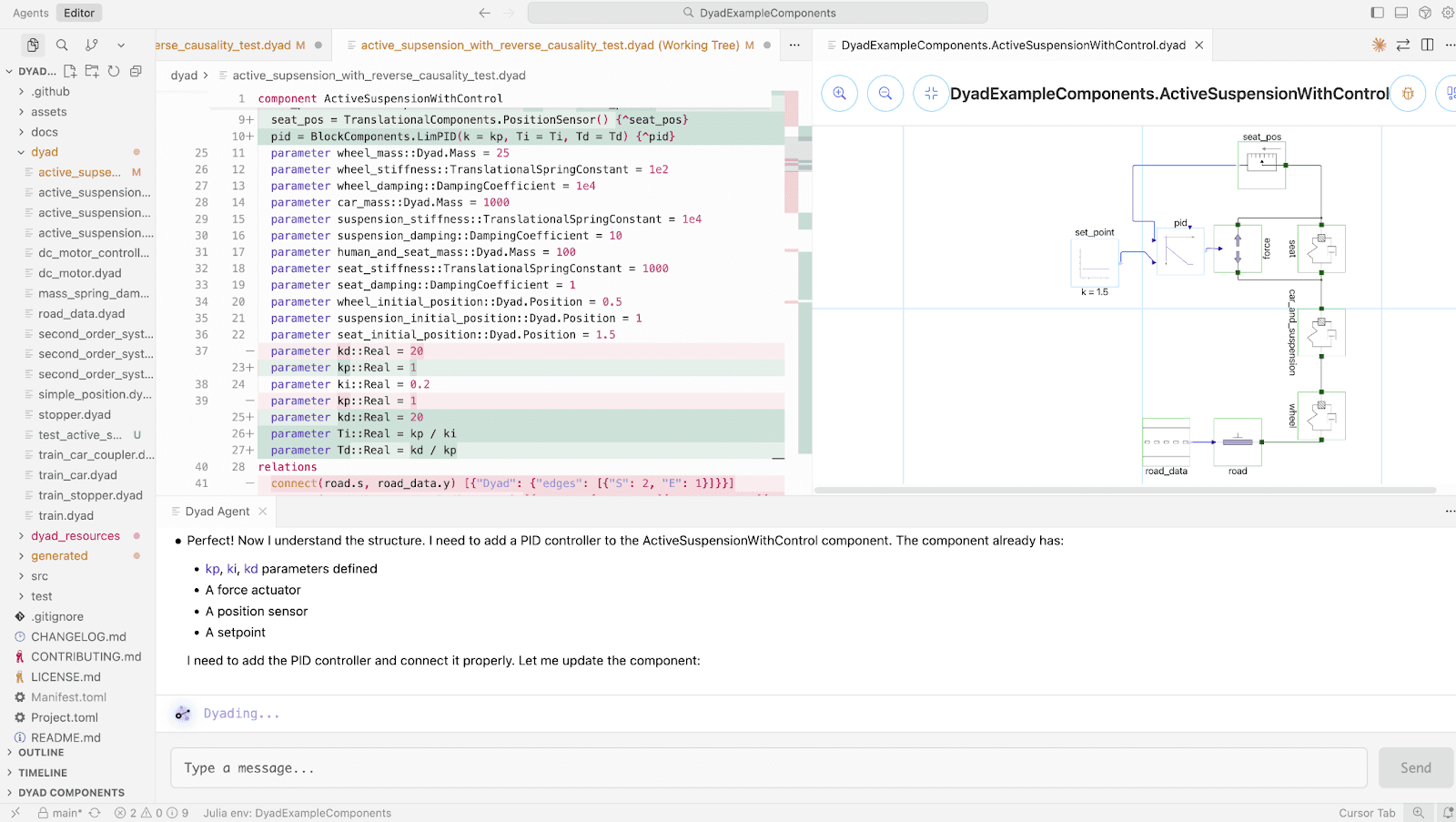
With Dyad AI, engineers review and guide while agents execute the end-to-end workflow to validate behavior, tune parameters, and refine designs through automated, physics-grounded loops. Dyad follows an engineer-in-the-loop pattern: agents iterate; humans direct system-level decisions. Work that once required deep domain expertise and extensive coding becomes a continuous, physics-based process.
According to Dr. Viral Shah, CEO and Co-Founder of JuliaHub, Dyad AI supports the shift where AI must engage directly with scientific and engineering reasoning.
“Dyad operates at the level of engineering, not code,” said Dr. Shah. “Most agentic tools stop at producing syntax. Dyad AI engages equations, constraints, and physical laws, integrating simulation, parameterization, performance testing, and automated calibration so agents can co-design systems grounded in real physics. This is where AI for Science is moving, AI collaborating with engineers on models, behavior, and validation to close the loop between intent and verified performance.”
Dyad AI is the first agentic environment built for hardware engineering workflows, unifying language, compiler, and simulation engine into one platform designed for AI-driven scientific work. The full generate > simulate > validate > refine loop runs natively inside the environment, enabling agents to continuously test, correct, and improve designs.
The Need for Agentic Hardware Intelligence
General-purpose coding assistants can generate syntax, but scientific and engineering work demands agents with semantic reasoning over physical systems, a defining requirement of AI for Science.
Teams must be able to:
Derive governing equations and verify physical coherence·
Model coupled, multi-physics behavior
Validate units, energy balance, and boundary conditions
Iterate until the solution satisfies all physical constraints
Legacy simulation tools, developed long before agentic AI existed, lack the representational structure required for agents to understand equations, constraints, and physical laws. Their architectures cannot support agentic workflows without complete rebuilds, leaving a widening gap between today’s engineering needs and yesterday’s tools. This complexity contributes to a longstanding industry challenge: despite decades of availability, traditional simulation environments still see limited adoption due to steep learning curves and rigid architectures.
Dyad AI addresses these limitations with a physics-aware reasoning substrate: a unified interface, language, compiler, and simulation engine built natively for agentic engineering. For the first time, the full scientific workflow runs inside a platform designed for AI to think, test, explain its reasoning, and improve.
Agentic AI for Engineering Workflows
Dyad AI enables agents to perform engineering tasks end-to-end:
Research formulations and governing equations
Assemble components into physical systems
Generate, run, and interpret simulations
Calibrate and tune parameters
Validate behavior against physical laws
Justify reasoning behind every decision
Users provide direction while Dyad AI executes deep computational and scientific work. This marks the arrival of agentic hardware engineering, where modeling, simulation, analysis, and code generation operate inside a single, AI-native physics environment. As engineering teams embrace AI-driven development workflows, agentic AI becomes essential for manufacturers, hardware developers, and product designers.
Correct by Construction
Dyad AI embeds rigorous scientific safeguards directly into its reasoning stack, including:
Unit and dimensional analysis
Type-safe physical connections
Multi-domain validation
Energy and mass-flow consistency checks
Executable, traceable documentation
The result is not merely models that run, but models that conform to the laws of physics. From brakes to batteries to pumps, Dyad AI moves teams from design intent to validated simulation in minutes, ensuring engineers always work from correct-by-construction foundations.
Democratizing Agentic AI
Engineering complexity is rising, development cycles are compressing, reliability expectations are tightening, and the pressure to innovate is accelerating. Legacy tools, rigid, cumbersome, and architecturally incompatible with agentic workflows, cannot meet growing demands.
Dyad AI changes all of this:
10x productivity improvements
100x faster simulation and analysis
Significantly lower development costs
Greater innovation
Accelerated development cycles
By enabling agents to manage formulation, simulation, and early-stage validation, Dyad AI brings advanced modeling and simulation within reach of the global engineering community of over 15 million strong. As the industry shifts toward AI-native product development, agentic AI becomes the foundation of competitive engineering.
The Foundation for AI-Native Engineering
Dyad AI positions JuliaHub at the forefront of the global AI for Science revolution, where tools no longer simply assist engineers, they collaborate with them, close engineering loops autonomously, and deliver validated systems at unparalleled speeds. Dyad AI is not a feature add-on; it is a foundational architecture for the next era of engineering intelligence.
About JuliaHub
JuliaHub empowers scientists and engineers with cutting-edge tools for scientific machine learning (SciML), Digital Twin modeling, and advanced simulations. Dyad supports high-performance multi-physics modeling, integrating traditional methods with AI-driven approaches to solve complex engineering challenges. JuliaHub, the cloud platform, streamlines Julia program development, deployment, and scaling while ensuring enterprise-grade security, governance, and compliance. For more information, visit www.juliahub.com
# # #